
What Is Hardtack?
A plain biscuit with a surprisingly long trail through maritime history, migration, military rations, and now the name of a digital studio.
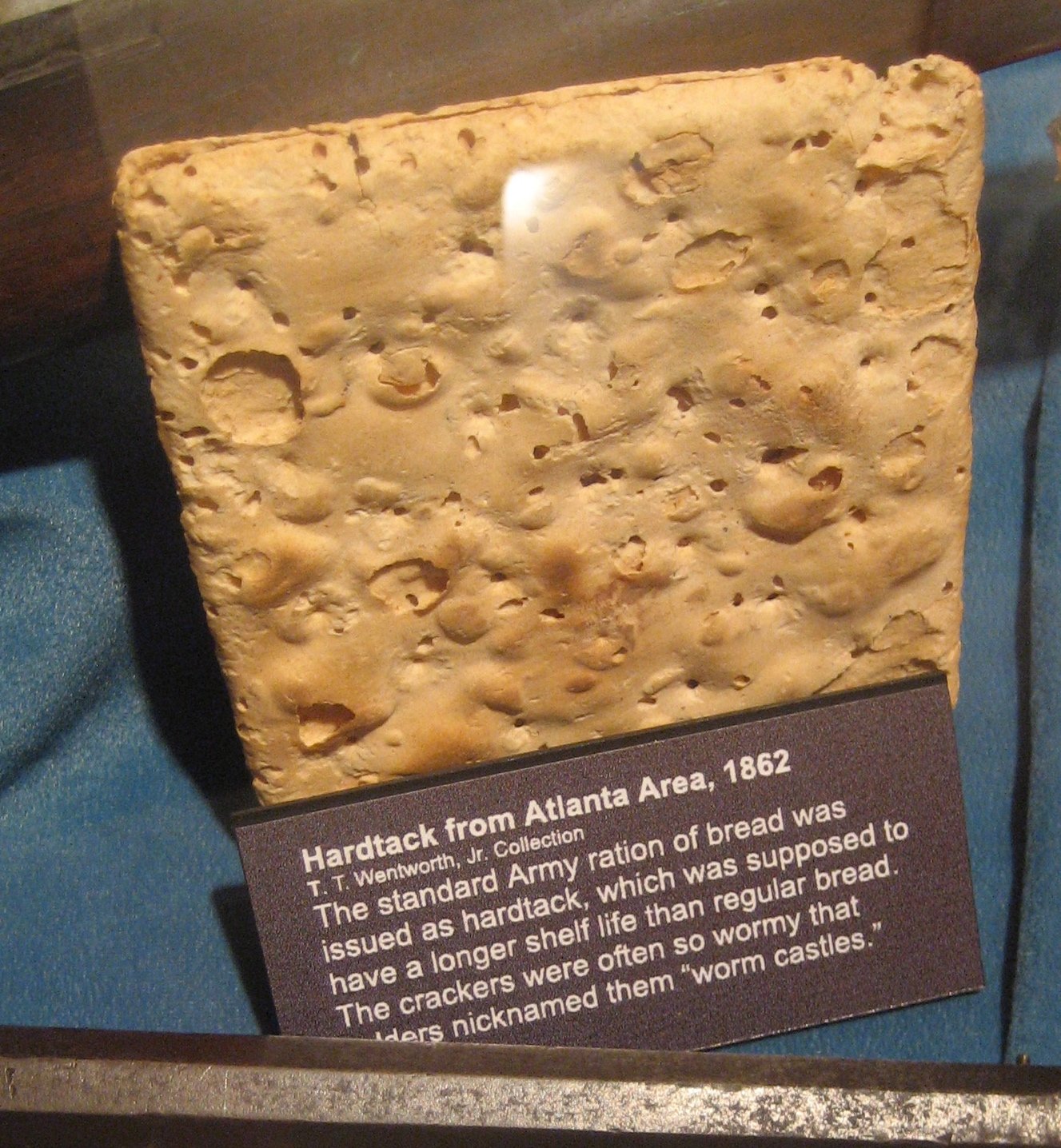
Hardtack is a dense, low-moisture biscuit made from flour and water, sometimes with salt. It is plain by design. When it is baked thoroughly and kept dry, it tolerates storage and rough transport far better than fresh bread. That made it useful aboard ships, in wagon trains, and wherever regular baking was impossible.
The American Civil War made hardtack famous in the United States, but it did not invent it. The food is older than the name.
Before it was called hardtack
People have baked dry travel breads for centuries. Ancient Roman accounts mention bucellatum, while medieval and early-modern ships carried forms of sea bread or ship’s biscuit. These foods belong to the same broad family, but they were not one unchanged recipe handed down across every century. It is more accurate to describe gradual development than to name a single inventor or origin date.
Royal Museums Greenwich notes references to Richard I provisioning his ships with a durable mixed-grain biscuit in 1190. By the age of the Spanish Armada, shipboard ration tables included substantial daily allowances of biscuit. Samuel Pepys later helped regularize Royal Navy victualling, including a daily ration of well-baked wheaten biscuit.
Why ship’s biscuit worked
The idea was simple: remove as much moisture as practical. Royal Museums Greenwich describes ship’s biscuit as a stiff dough of flour, water, and salt, baked and then left to harden and dry. Without the moisture and fat found in softer breads, it deteriorated more slowly when stored well.
Long-lasting did not mean indestructible. Damp storage could lead to mold, and insects were a recurring problem aboard ships and in military supply systems. The same dryness that helped preserve the biscuit also made it notoriously difficult to chew.
When the word appeared
The word hardtack is much younger than durable ship’s bread. Wikipedia’s hardtack history, citing the Oxford English Dictionary, traces tack to British sailor slang for food and gives 1830 as the earliest recorded use of hardtack.
By the American Civil War, square hardtack was shipped in enormous quantities to soldiers. That nineteenth-century association explains why many people assume it began with the war. In reality, Civil War hardtack was an American version of a much older provisioning solution.
How people actually ate it
Fresh hardtack was hard. Old hardtack could be harder. Soldiers and sailors softened it in coffee, water, soup, or broth. They crushed it into crumbs, fried it in fat, or worked it into a rough pudding when other ingredients were available. Civil War veteran John D. Billings recorded several of these methods in his 1887 book Hard Tack and Coffee.
The less pleasant stories are real, too. Poorly stored biscuits could carry weevils or larvae. Soldiers sometimes floated the unwelcome passengers out in coffee before eating the softened biscuit. Nicknames such as “molar breakers” and “worm castles” were dark humor rooted in experience.
Why the name fits Hardtack Digital
Hardtack was not luxurious, fashionable, or complicated. It was understandable, portable, and useful when conditions were rough. Its value came from doing a basic job dependably with very little excess.
That is the idea behind Hardtack Digital: thoughtful design and technology built to remain useful, maintainable, and understandable after launch.
Make your own hardtack
This is a practical Civil War-style formula adapted from the Third U.S. Regular Infantry reenactors’ recipe. Royal Museums Greenwich documents a similar ship’s biscuit made from flour, water, and salt.
Ingredients
- 3 cups all-purpose or whole-wheat flour
- 1 cup water
- 2 teaspoons fine salt (optional in some historical versions)
Method
- Heat the oven to 375°F (190°C).
- Mix the flour and salt. Add the water gradually and work it into a very stiff dough. If it remains crumbly, add water a teaspoon at a time. If it is sticky, work in a little more flour.
- Knead just until the dough is uniform, then roll it about 1/2 inch (12 mm) thick.
- Cut the dough into roughly 3-inch squares. Use a skewer, chopstick, or similar tool to punch four rows of four holes through each piece.
- Place the pieces on an ungreased baking sheet. Bake for 30 minutes.
- Turn each piece over and bake for another 30 minutes, until dry and lightly colored.
- Cool completely on a rack. Do not seal the biscuits while any warmth or moisture remains. If a center is still soft, return the batch to a low oven and continue drying.
Storage and eating
Only store hardtack after it is completely dry and cool. Keep it in a clean, airtight container away from humidity. Home preparation does not establish a commercial shelf life, so do not assume a batch will remain safe indefinitely. Discard any piece that becomes damp, moldy, infested, or develops an unusual odor.
Dental warning: fully dried hardtack can become extremely hard. Do not bite down forcefully. Soften it in coffee, water, soup, or broth, or break it carefully before eating.
Sources and further reading
- Hardtack, Wikipedia, including its source notes and bibliography.
- The ship’s biscuit, Royal Museums Greenwich.
- How to make a ship’s biscuit, Royal Museums Greenwich.
- Hard Tack and Coffee, John D. Billings, 1887.
- How to make hardtack, Third U.S. Regular Infantry reenactors.
- Historic hardtack photograph and licensing information, Wikimedia Commons.